'%20stroke-width='8'%20stroke-linecap='round'%20stroke-linejoin='round'/%3e%3ccircle%20cx='42'%20cy='83'%20r='4.25'%20fill='%23D6679A'/%3e%3ccircle%20cx='87'%20cy='58'%20r='4.25'%20fill='%23796BC4'/%3e%3cpath%20d='M94%2019l3.3%207.7L105%2030l-7.7%203.3L94%2041l-3.3-7.7L83%2030l7.7-3.3L94%2019Z'%20fill='%23BE892F'/%3e%3c/svg%3e)
Why NovelForge
Why NovelForge · choose the fiction system that matches the hardest part of your project DIRECT SYSTEMS AUTHOR PRODUCTS DIFFERENTIATORS TRADEOFFS 简体中文 · Docs Home

Why NovelForge · choose the fiction system that matches the hardest part of your project
DIRECT SYSTEMS AUTHOR PRODUCTS DIFFERENTIATORS TRADEOFFS

Why NovelForge
Section titled “Why NovelForge”NovelForge is not trying to prove that other fiction systems lack memory, quality checks, reader simulation, multi-agent execution, or publishing features. Many current alternatives implement those mechanisms well.
Its narrower claim is architectural:
NovelForge is for fiction projects that need story authority, semantic model judgment, recoverable execution, quality evidence, and Canon mutation to remain explicitly separate even as the project grows across many chapters, sessions, models, and revisions.
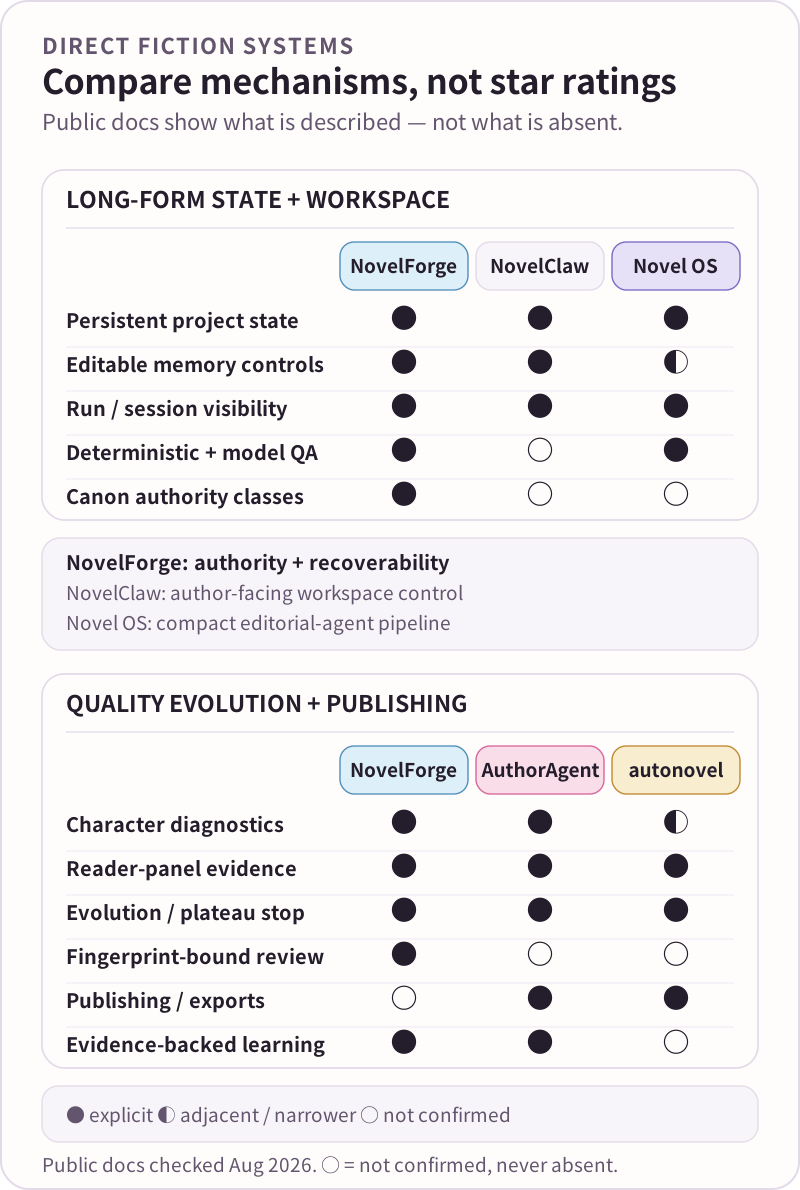
Comparison snapshot: August 14, 2026. Public product documentation changes quickly. “Not confirmed” means only that a mechanism was not verified in the cited public material; it never means the product cannot do it.
01 · The fastest decision rule
Section titled “01 · The fastest decision rule”Choose the tool whose strongest design matches your actual bottleneck.
Sudowrite is a strong fit when the priority is a mature AI writing partner for planning, drafting, brainstorming, rewriting, and organizing a novel around a persistent Story Bible.
NovelCrafter is a strong fit when the priority is a structured author workspace with planning views, Codex organization, series-level sharing, collaboration, and flexible control over how much AI participates.
NovelClaw is a strong fit when you want long-form writing as an inspectable workspace: continuing sessions, visible runs, manuscript / storyboard views, character / world / style surfaces, and editable memory banks.
Novel OS is a strong fit when you want a writing studio built around central persistent StoryState, a legible five-role editorial pipeline, deterministic continuity checks plus an LLM Guardian, broad provider support, and book export.
AuthorAgent is a strong fit when you want a local-first author application spanning the whole book lifecycle: planning, writing, evidence-chained quality checks, character critics, candidate evolution, memory, publishing, and export.
autonovel is a strong fit when you want a highly autonomous research-style pipeline that can move from seed to world / characters / outline / canon, sequential drafting, evaluation, reader-panel revision, plateau stopping, and final PDF / ePub / audiobook / landing outputs.
NovelForge is a strong fit when the hardest problem is not getting another completion, but governing what is true, what the model is allowed to infer, what survives across runs, which evidence can change which state, how a failed revision routes upstream, and exactly when accepted prose is allowed to mutate Canon.
02 · Where NovelForge is actually different
Section titled “02 · Where NovelForge is actually different”The strongest NovelForge differentiators are not isolated features. They are boundaries between features.
Story authority is explicit
Section titled “Story authority is explicit”NovelForge distinguishes locked, accepted, active_plan, review, and proposal rather than treating every durable story note as one undifferentiated source of truth.
Session memory, model inference, review output, Corpus evidence, a scenario branch, and an active plan remain different authority classes.
That distinction becomes expensive to ignore when a project lives for dozens or hundreds of chapters.
Canon mutation is a transaction
Section titled “Canon mutation is a transaction”Passing QA does not write Canon. User acceptance does not itself mean the write completed.
SETTLE requires explicit accepted-artifact evidence, write authorization, before-state verification, exact mutation intent, required projection receipts, and postcondition checks. A before-state mismatch or required projection failure produces settlement_incomplete rather than “close enough.”
This is a more formal model than treating “saved memory” or “approved chapter” as synonymous with canonical state.
Semantic intelligence and deterministic runtime are deliberately separate
Section titled “Semantic intelligence and deterministic runtime are deliberately separate”The current development architecture makes literary interpretation model-owned through progressively disclosed semantic contract packs.
The model handles questions that actually require reading: character action, scene resolution, reader reaction, character integrity, revision diagnosis, long-horizon reconciliation, and candidate comparison.
Deterministic code handles what should be exact: permissions, fingerprints, persistence, sessions / checkpoints, result binding, consume-once behavior, hard budgets, rights gates, transactions, and reproducible builds.
The Framework therefore does not need to pretend that a Python heuristic is a literary critic.
Character action precedes scene convenience
Section titled “Character action precedes scene convenience”The story-simulation contracts can propose character-owned actions from agenda, belief, knowledge, relationship, and scene evidence before resolving the scene-level collision.
The design goal is to prevent the outline from speaking through every important character.
Context is sparse and inspectable
Section titled “Context is sparse and inspectable”NovelForge separates Project storage from prompt context. Context / Memory tooling owns hard budgets, provenance, authority classes, and author-visible controls; genuine relevance judgment can be delegated to a semantic contract.
Persistent memory is treated as a governed derived view, not an invisible license to keep injecting everything the system has ever seen.
Quality routes failure instead of accumulating patches
Section titled “Quality routes failure instead of accumulating patches”Surface, Reader, Character, Story, Continuity, Context / Memory, Research, and Runtime failures have different repair owners.
A polished but inert scene can return to Reader Pressure + Scene Simulation. Character distortion returns to Character Simulation. A causal premise failure returns to Story / Plan. A stale fingerprint returns to runtime validation.
The point is not “more critics.” It is repairing the mechanism that owns the defect.
Revision can admit that it did not improve
Section titled “Revision can admit that it did not improve”Quality Evolution keeps candidate fingerprints and lineage. Model-owned comparison can keep the incumbent, accept the challenger, or return a tie. Plateau stopping prevents endless rewrite churn when another pass has stopped buying meaningful improvement.
Independent judgment is explicit rather than theatrical
Section titled “Independent judgment is explicit rather than theatrical”Semantic judgment is not automatically independent judgment.
When a rubric genuinely requires independence, NovelForge requires a separate invocation / session, bounded packet, exact fingerprint binding, typed result, and fresh review after material changes. A valid semantic rejection routes repair; it is not an excuse to keep changing reviewers until one says PASS.
Runtime is provider-neutral without confusing capability with authority
Section titled “Runtime is provider-neutral without confusing capability with authority”Current chat, peer chat, local Codex / Claude, provider APIs, MCP workers, GitHub jobs, local models, and humans can all be eligible execution routes when the host actually exposes the required capability.
But capability never grants Canon authority.
Learning remains evidence-bound
Section titled “Learning remains evidence-bound”Preference hypotheses, Corpus observations, evaluation evidence, and General Craft candidates are kept separate. Learning can be contradicted, scoped, versioned, evaluated, promoted through explicit gates, and rolled back.
The model cannot simply infer a user preference once and make that preference permanent.
03 · Where other systems are stronger
Section titled “03 · Where other systems are stronger”NovelForge is not the strongest system in every dimension.
Mature author UX: Sudowrite and NovelCrafter
Section titled “Mature author UX: Sudowrite and NovelCrafter”Both are finished author products rather than engineering frameworks. Sudowrite’s official docs describe an integrated planning / writing toolkit around a persistent Story Bible; NovelCrafter provides planning modes, Codex organization, series sharing, collaboration, and author-controlled AI assistance.
NovelForge currently asks users to work closer to the Project / runtime system. Its author-facing UI is much less mature.
Visible long-form workspace: NovelClaw
Section titled “Visible long-form workspace: NovelClaw”NovelClaw exposes the work directly: sessions, run inspection, manuscript review, storyboard, character / world / style surfaces, editable memory banks, logs, chapter files, and downloads.
NovelForge currently has stronger emphasis on authority and execution contracts than on giving authors a polished visual control surface.
Legible editorial studio: Novel OS
Section titled “Legible editorial studio: Novel OS”Novel OS’s Architect → Scribe → Editor → Guardian → Curator model is immediately understandable, while its browser studio makes planning / writing / revising and continuity findings visible. It also supports a broad provider layer and document exports.
NovelForge intentionally refuses to make fixed editorial roles the core architecture. That improves routing flexibility, but makes the system less instantly theatrical and less app-like.
End-to-end author and publishing breadth: AuthorAgent
Section titled “End-to-end author and publishing breadth: AuthorAgent”AuthorAgent publicly describes contradiction detection, per-character critics, specialist revision, Prose Evolution, reader panels, durable lessons, long-book memory, KDP-ready DOCX / EPUB3, audiobook preparation, cover workflows, and publishing / launch tooling.
NovelForge has no equivalent ambition to own the full publishing business workflow today.
Autonomous artifact production: autonovel
Section titled “Autonomous artifact production: autonovel”autonovel explicitly connects foundation generation, sequential chapter evaluation, automated revision, reader panels, plateau detection, manuscript review, typesetting, illustration, audiobook generation, ePub, and landing-page output.
NovelForge is more conservative about authority and Project state, but much narrower in downstream artifact production.
04 · The comparison should be read as architecture, not feature count
Section titled “04 · The comparison should be read as architecture, not feature count”Several current systems now share mechanisms that once looked distinctive:
- persistent story state;
- memory systems;
- deterministic continuity checks;
- character-focused critics;
- reader panels;
- candidate evolution / stopping conditions;
- multi-provider or local-model support;
- inspectable runs;
- long-form project workspaces.
So “we have memory” or “we have agents” is no longer a meaningful differentiator.
The useful comparison is what authority that state carries, how interpretation is separated from deterministic machinery, how failures are routed, how a result is bound to the artifact it judged, how work resumes after interruption, and what must happen before story truth changes.
That is the layer where NovelForge makes its strongest design bets.
05 · Mature author products and open frameworks solve different jobs
Section titled “05 · Mature author products and open frameworks solve different jobs”Sudowrite and NovelCrafter are primarily author-facing products. Their value is immediately visible in the writing experience: editor UX, project organization, planning surfaces, AI assistance, collaboration, and convenience.
NovelClaw and Novel OS increasingly occupy a middle ground: open fiction systems with substantial visible studio / workspace experiences.
AuthorAgent and autonovel push toward broad autonomous book pipelines, including downstream publishing artifacts.
NovelForge is closer to an engineering substrate for governed fiction production. Its center of gravity is Project authority, semantic contracts, recoverable execution, QA provenance, settlement, learning boundaries, and reproducible Framework / Project integration.
These categories overlap, but pretending they are identical leads to bad product comparisons.
06 · General agent frameworks belong one layer deeper
Section titled “06 · General agent frameworks belong one layer deeper”LangGraph, OpenAI Agents SDK, AutoGen, CrewAI, Google ADK, MCP ecosystems, and coding-agent runtimes matter to NovelForge as engineering references.
They influence questions such as:
- durable execution;
- sessions and state;
- typed handoffs;
- tool and guardrail contracts;
- MCP integration;
- local coding-agent execution;
- resumable workflows;
- multi-runtime capability routing.
But they are not the primary comparison set for “which system should I use to build / operate a long-form fiction project?”
07 · NovelForge is a strong fit when
Section titled “07 · NovelForge is a strong fit when”NovelForge becomes more valuable as several of these become true at once:
- the work spans many chapters, sessions, models, or contributors;
- the difference between plan, review, accepted fact, and proposal matters;
- character knowledge / agenda drift is a serious failure mode;
- context must be inspectable and budgeted rather than accumulated blindly;
- scene causality should be resolved before prose convenience;
- different quality failures need different repair owners;
- revisions should be compared rather than assumed better;
- some judgments genuinely require fresh independent execution;
- work must survive external waits, provider changes, and process restarts;
- accepted Canon mutations need exact before→after transactions;
- user taste / craft learning needs evidence, scope, evaluation, and rollback;
- the fiction project should be reproducible as a versioned software-like project.
08 · NovelForge is probably too heavy when
Section titled “08 · NovelForge is probably too heavy when”A lighter system is often better if the main job is:
- brainstorm a premise;
- write a short story in one or two sessions;
- generate alternate prose;
- line edit / polish an existing chapter;
- use a polished consumer editor with minimal setup;
- publish / format a book without needing a separate authority model;
- experiment quickly without maintaining Project contracts or runtime state.
Explicit locks, checkpoints, fingerprints, semantic receipts, authority classes, and settlement transactions are overhead. They should exist only when they prevent failures the project actually cares about.
09 · Current NovelForge tradeoffs
Section titled “09 · Current NovelForge tradeoffs”NovelForge deliberately accepts several weaknesses.
More ceremony. Explicit authority, checkpoints, fingerprints, contracts, and settlement are heavier than a memory-first writing assistant.
Semantic work costs latency and usage. Model / human interpretation cannot be made free merely by giving it a typed schema.
Independent gates cost even more. True independence may require another session, provider route, local agent, or human.
Smaller ecosystem and author UI. The Framework is much less mature as a consumer author application than the leading commercial writing products, and less visually complete than several current open fiction studios.
Publishing is not the center. DOCX / EPUB / cover / audiobook / launch workflows are not NovelForge’s current comparative strength.
Engineering discipline is required. A flexible multi-runtime architecture only works if Project authority, capability evidence, and result binding remain explicit.
These are real costs, not footnotes.
10 · Source policy for this comparison
Section titled “10 · Source policy for this comparison”The comparison uses public first-party product documentation and project repositories where possible.
For the homepage mechanism matrix:
● explicit means the public material clearly describes the mechanism.
◐ adjacent / narrower means a related mechanism is described, but the public scope is narrower or meaningfully different.
○ not confirmed means the mechanism was not confirmed in the checked public material. It does not mean “the product has no such capability.”
The matrix is intentionally conservative because product documentation is not a complete specification.
Current primary sources
Section titled “Current primary sources”- Sudowrite documentation:
https://docs.sudowrite.com/ - NovelCrafter:
https://www.novelcrafter.com/ - NovelClaw:
https://github.com/iLearn-Lab/NovelClaw - Novel OS:
https://github.com/mrigankad/Novel-OS - AuthorAgent:
https://github.com/Ckokoski/AuthorAgent - autonovel:
https://github.com/NousResearch/autonovel
For NovelForge implementation claims, the repository’s own current machine contracts and source files remain authoritative over this positioning page.

Specialization is useful only when it matches the failure modes you actually need to govern. ✦